Before You Start
How to Choose a Driving Instructor: What to Look For
What separates a good instructor from a great one — how to check qualifications, what to ask before booking, red flags to avoid, and why the right fit matters.
5 min read
Why It Matters More Than You Think
Your driving instructor shapes not just whether you pass your test, but how you drive for the rest of your life. A poor instructor can create anxiety, bad habits, and false confidence. A good one builds genuine ability, road sense, and the kind of calm that stays with you long after your test certificate arrives.
Price matters, but it shouldn't be the deciding factor. The difference between an instructor who charges £35/hr and one who charges £40/hr is £225 over 45 hours — far less than the cost of an extra ten lessons with someone who isn't right for you.
Check the Qualification First
Anyone charging money for driving lessons must be a fully qualified Approved Driving Instructor (ADI), registered with the DVSA. ADIs display a green octagonal badge in the windscreen of their car. This is a legal requirement — not just a nice-to-have.
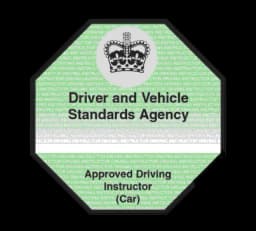
Green badge = fully qualified ADI
An ADI has passed three separate DVSA qualifying exams — a theory test, a hazard perception and driving ability test, and an instructional ability test. It is a serious qualification that takes most people over a year to achieve. Always check for the green badge before getting in the car.
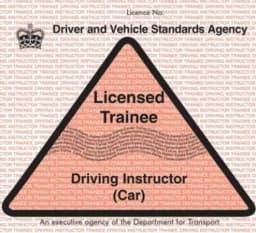
Pink badge = trainee instructor (PDI)
A pink badge means they are a Potential Driving Instructor (PDI) — still in training and not yet fully qualified. PDIs can legally give paid lessons under supervision, but their experience is limited. Lessons with a PDI are often cheaper — weigh that saving against the difference in experience.
Verify on the DVSA register
You can check whether an instructor is registered with the DVSA using the official online register. Enter their name or ADI licence number to confirm their status.
Check the DVSA registerManual or Automatic?
Decide whether you want to learn in a manual or automatic car before you start looking. Not all instructors teach both, and your choice determines which licence you end up with — an automatic licence restricts you to automatics only, while a manual licence covers both.
If you are planning to drive an electric car (all of which are automatic), or if you simply want to pass as efficiently as possible, learning in an automatic removes a significant layer of complexity from your lessons and lets you focus entirely on road craft. Many learners pass faster and with fewer hours in an automatic for this reason.
Questions to Ask Before You Book
A good instructor will answer these without hesitation. Vague answers, pressure to commit immediately, or irritation at being asked are all warning signs.
“Are you a fully qualified ADI?”
Confirms they hold the green badge and are on the DVSA register. Don't skip this.
“What is your first-time pass rate?”
A good instructor will know this figure. Bear in mind the national average is around 47% — a good local instructor should be above this consistently.
“How do you structure lessons — do you follow a set syllabus?”
The DVSA has a national driving standard (the "driving licence acquisition standard"). Good instructors work through it systematically rather than just driving around aimlessly.
“How much notice do I need to give to cancel a lesson?”
Most instructors charge for late cancellations (usually within 24–48 hours). Know the policy before you commit.
“Do you offer block bookings, and is there a discount?”
Block bookings usually cost less per hour and help maintain lesson momentum. Ask upfront rather than after you've already paid.
“Do you know the local test routes?”
An instructor familiar with your test centre's common routes gives you a practical advantage on test day. This is especially relevant for local independent instructors vs. national franchise schools.
“Can I have a trial lesson before committing to a block?”
Always take a trial lesson. Chemistry matters — if you don't feel comfortable asking questions or admitting mistakes, your progress will suffer.
What a Good Instructor Looks Like
Explains things clearly without making you feel stupid for not knowing
Gives you feedback that is specific and actionable, not just "that was fine"
Adapts their teaching style to how you learn — not a one-size-fits-all approach
Is honest about your progress, including when you're not quite ready for a test
Encourages you to ask questions and make mistakes without anxiety
Is punctual, professional, and has a clean, roadworthy car with dual controls
Red Flags to Walk Away From
Pressure to buy a large block of lessons before you've had a trial lesson
Vague or evasive answers about their pass rate or qualifications
No dual controls in the car — this is a basic safety requirement for learner instruction
Consistently late, distracted by their phone, or dismissive during lessons
Telling you you're ready for a test when your gut (and their own mock test feedback) says otherwise
No formal lesson structure — just driving around with no clear progression or feedback
Independent Instructors vs. Franchise Schools
National franchise schools (AA, BSM, RED) have recognisable brands and online booking systems, but the quality of instruction varies enormously between individual instructors within the same franchise. The brand name is no guarantee of quality.
Independent ADIs
- → Often have deeper local knowledge of test routes
- → More flexible with scheduling and pricing
- → You build a direct relationship with one consistent instructor
- → Pass rate is personal — easy to evaluate
- → Less brand recognition but often better value
Franchise schools
- → Easier to book online, sometimes at short notice
- → Instructor quality varies widely within the same brand
- → Changing instructors can be straightforward if one isn't working for you
- → May be better resourced for intensive courses
- → Can be harder to assess individual pass rates
Related Guides
Cost of Learning to Drive
A complete breakdown of every fee you'll pay — provisional licence, theory test, practical test, and lessons — plus the hidden costs most guides don't mention.
Step-by-Step to Your Licence
From applying for your provisional to receiving your full licence — every stage explained in order, with official timelines and what to expect at each step.
Driving an Electric Car
How driving an electric car differs from a petrol or diesel — regenerative braking, instant torque, one-pedal driving, and why an EV is one of the best cars to learn in.
Ready to get started?
Automatic electric driving lessons on the Wirral — one-to-one with a qualified ADI.
Book a Lesson